
Carmen Colabella

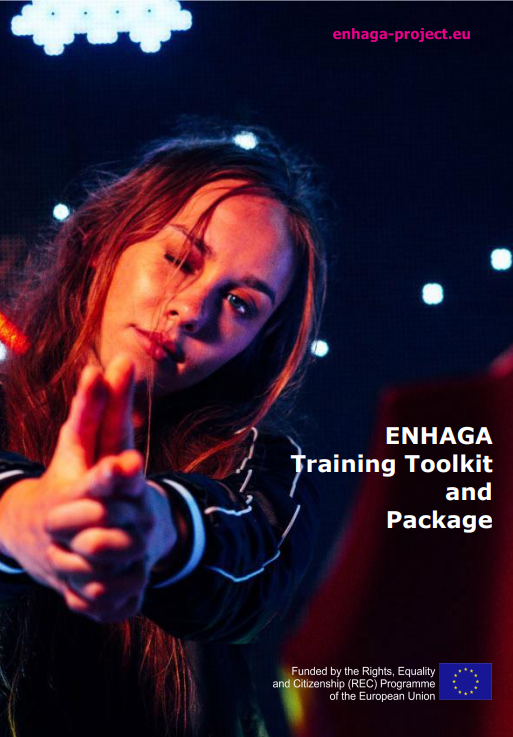
The ENHAGA (End Sexual Harassment in Gaming) project was a European initiative created to tackle online harassment in video games. Between 2020 and 2022, it developed concrete tools, including an interactive game and training materials, anticipating many of the European policies that are now taking shape. Here is how and why.
In February 2026, during Safer Internet Day 2026, the European Commission announced a new action plan against cyberbullying. Prevention, reporting tools, support for victims and coordination between Member States are the pillars on which the European strategy to make the digital spaces frequented by young people safer is being built.
Within this context, ENHAGA, an EU-funded project, represents much more than a now concluded initiative. It was an experiment that, several years earlier, had already begun working on these same issues, but within the context of gaming. Sociologist Thanos Theofilopoulos, , who took part in the implementation of the project on behalf of the non-profit organisation Symplexis, carrying out research and training activities, explains: «What makes ENHAGA aligned with this broader European agenda is the fact that it addressed the same policy direction that the European Union later strengthened at an institutional level: safer digital environments for children and young people, better reporting and support mechanisms, stronger prevention and awareness work and a more explicit recognition of online gender-based violence».
The ENHAGA website is no longer active. Yet today more than ever, that project seems to speak directly to the present.
Thanos Theofilopoulos
Thanos Theofilopoulos is a sociologist specialising in gender equality, the prevention of gender-based violence, LGBTQI+ rights, anti-discrimination and the prevention of hate crime and extremism. He has extensive experience in managing and carrying out research projects in these fields in collaboration with universities and civil society organisations. He works at the KETHI (Research Centre for Gender Equality in Greece) as scientific supervisor of national support structures for victims of gender-based violence and as a researcher at the NGO Symplexis on EU-funded projects. He participated in the implementation of the ENHAGA project on behalf of Symplexis as a researcher and trainer.
The game: simulating reality to recognise it
At the heart of the project was a game, designed as a single-player experience and built around realistic situations: the player followed a story that unfolded progressively and, at every stage, was asked to choose how to react. The aim was to “learn” what online harassment was, to train recognition and responses to situations that crossed the line, to understand which tools to use and the consequences arising from each choice. In other words, the game functioned as a social simulation: it showed that harassment is difficult to identify and is built over time, often beginning with apparently harmless interactions. Above all, it showed that the problem is structural rather than episodic.
Behind this approach lay an equally significant process of development. As Thanos recalls, «it was a genuinely collaborative process, in which every organisation actively contributed to the development and revision of the content». The project was coordinated by the Center for Social Innovation1, but every organisation involved contributed directly to the development: «each partner developed a section of the game, which was then shared, reviewed by the others and integrated into a common final version». Added to this was the involvement of professionals from the gaming sector, such as Ten Ton Train, and designers who worked continuously on the project, holding weekly meetings to revise scenes and content, giving rise to a truly hybrid product built between social research and game design.

Normalising violence, then and now
The game «was built on the basis of research findings, which included interviews and focus groups with female players and professionals» because, as Thanos underlines:
«Gaming is a social and cultural space in which young people build relationships, identities and a sense of belonging».
«What surprised us was the fact that certain dynamics of exclusion and violence were often considered normal, embedded within the everyday dynamics of gaming». The testimonies collected spoke of adaptation: female players hiding their gender by using male avatars, limiting contact with other players or avoiding certain multiplayer modes altogether. «Many female players had already adapted their behaviour in order to feel safer, changing the way they participated in online environments».
«What is worrying is that, even today, online abuse is still considered somehow less serious because it takes place in a digital context».
And this underestimation of online abuse does not concern individual perceptions alone, but also runs through institutional responses. A comparative study on Australia and the United Kingdom published in the Journal of Family Violence2 in 2025, for example, shows how technology-facilitated domestic violence is often recognised with difficulty by law enforcement, especially when it does not produce immediately visible physical harm.
«These digital environments reproduce broader social inequalities and gender stereotypes, and for many young women the consequences are very real», Thanos continues.
The study by Nanclares, Romero-Seseña and Pereda, published in 2025 in the European Journal on Criminal Policy and Research3, confirms this: digital communities linked to video games are spaces in which social and gender vulnerabilities are amplified. In a representative sample of 1,812 adult gamers in Spain, 19.6% reported having experienced forms of sexual victimisation; the percentage rose to 22.3% among women and reached 32.1% among the youngest participants, aged between 18 and 25.
These behaviours were, and still are, behaviours that target women precisely because they are women, «closely connected to gender-based violence and to the broader inequalities present within society. Another significant element in our research was also observing how early these experiences could begin and how deeply they could affect the people involved. Sexual harassment in gaming did not remain confined to a single isolated channel: it occurred in group chats, private chats and often extended onto social media as well».
Often, the lack of responses to all this is not due to our relationship with the digital world, but to our relationship with one another. Without adequate sex and relationship education, digital and non-digital spaces alike remain, even today, difficult territories to inhabit. When, instead, a safe space is created in which people can exist, something changes. As Thanos states: «The project allowed people to feel more comfortable sharing experiences they had never spoken about before».
The ENHAGA impact
Stefano aims to «find the courage to be himself again without fearing judgement» and to «learn to choose his own identity without allowing himself to be defined by others, even if that means being alone for a while». Sofia wants to experience «gaming as a space of freedom and genuine connection, but without losing sight of reality and her own safety». These are two of the characters in The Game Changers, the video game presented by the Safer Internet Centre, during the national campaign “Il Mese della Sicurezza in Rete (MESIC)”4, designed for pre-adolescents aged between 9 and 12 and created to support schools.
The ENHAGA website may no longer exist, and many European projects have a limited lifespan even in terms of their infrastructures: websites, platforms and digital tools often do not survive beyond the funding period. Yet, as Thanos explains:
«The sustainability of a project should not be measured solely by the existence of the website or the game online, but by the dissemination, impact and possibility of reusing its results over time».
The Game Changers, for example, guides players through interactive episodes — mini-games, puzzles and narrative choices — that make it possible to address the problematic aspects of the digital world from a safe perspective. The plot follows five friends who are sucked into their computer and find themselves lost within an empty, dark universe in which four spaces emerge: grooming, phishing, cyberbullying and parental control.
As in ENHAGA, victory is not something that can be achieved as separate individuals, but only collectively: as a group of five within the dynamics of the video game, and as a class and as a society in real life. Projects such as ENHAGA, which involved hundreds of gamers, reached more than 145,000 people and produced tools designed to be studied, adapted and recreated, have contributed to the emergence of the fertile cultural foundation necessary for formal regulatory recognition. By recognising part of the responsibility borne by platforms, the project effectively helped establish the paradigm shift later enshrined in the European BIK+ (Better Internet for Kids)5, strategy, adopted in 2022, and in the DSA (Digital Services Act)6, which came into force in 2024. What is illegal offline must also be illegal online: today, digital service providers are required to produce rigorous assessments of systemic risks, demonstrating how their moderation and recommendation systems intervene preventively to mitigate online violence.


- Read more about the Center for Social Innovation: https://csicy.com/ ↩︎
- Read more: Douglas, H., Tanczer, L., McLachlan, F., & Harris, B. (2023). Policing Technology-Facilitated Domestic Abuse (TFDA): Views of service providers in Australia and the United Kingdom. Journal of Family Violence, 40(2), 341–352. https://link.springer.com/article/10.1007/s10896-023-00619-2? ↩︎
- Read more about this study: Nanclares, E., Romero-Seseña, P., & Pereda, N. (2025). Unsafe Play: Understanding sexual victimization in digital gaming communities. European Journal on Criminal Policy and Research. https://link.springer.com/article/10.1007/s10610-025-09642-z ↩︎
- Visit the website: https://www.generazioniconnesse.it/site/it/2026/02/10/mesic-2026/ ↩︎
- BIK+ is the European Commission’s official strategy aimed at guaranteeing that minors are protected, respected and empowered in the digital world; it puts the concept of “Safety by Design” into practice. For further information: https://better-internet-for-kids.europa.eu/en ↩︎
- To understand the Digital Services Act: https://digital-strategy.ec.europa.eu/it/policies/digital-services-act. This European Union regulation sets out strict standards for online safety, starting with the removal of illegal content through rapid and timely reporting mechanisms. The package also includes a ban on targeted advertising based on sensitive categories (such as sexual orientation, religion or ethnicity) and a total ban on advertising profiling aimed at minors. In terms of transparency, platforms are now obliged to clarify their moderation criteria and the functioning of their recommendation algorithms through regular reports. Breaches of these rules may result in extremely severe financial penalties, of up to 6% of the company’s global annual turnover. ↩︎