
How to Care
Rituals, herbs and witches in the Bakota of Olena Kayinska and Camille Bleu-Valentin

Alessandra Navazio
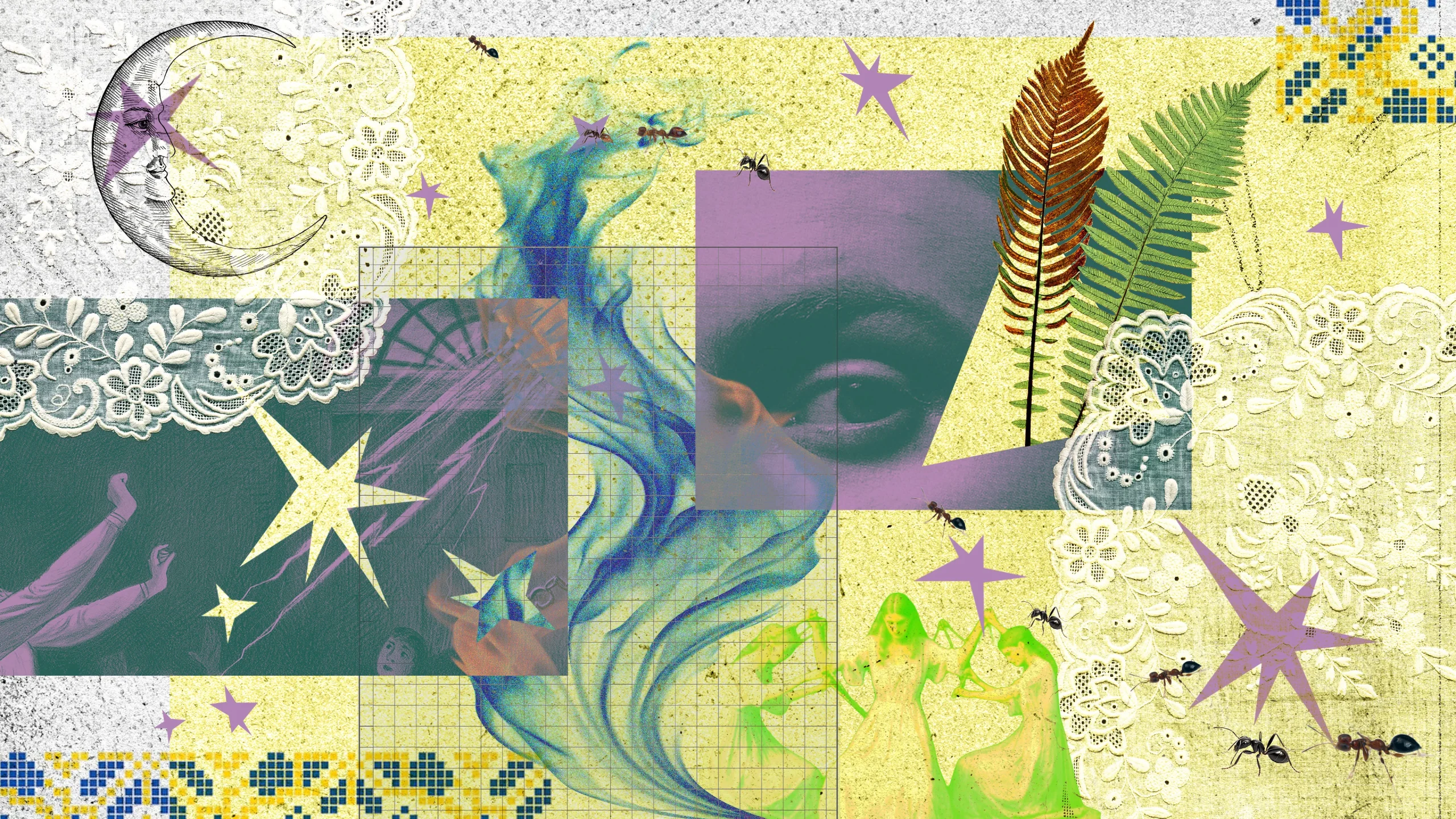
Where there are no clinics or pharmacies, care in the villages around Bakota (Ukraine) also comes from healers and herbs. During the artist residency in the region, Olena Kayinska knocked on the doors of the last witches, while Camille Bleu-Valentin followed the medicinal plants of the land. Their research became stories, paintings, maps and a bioplastic to be dissolved in water, for the guide Bakota: A Portal to Ukraine. Two of its six itineraries, both questioning the relationship between care, body and landscape.
“We work harder.” That is the answer some inhabitants of the villages around Bakota gave when asked what they do on sad days. Bakota is an ancient town on the Dnister River, in western Ukraine, flooded between 1981 and 1987 by a hydroelectric reservoir. The villagers are farmers, and when they feel unwell, they spend even more time in the fields. French artist Camille Bleu-Valentin remembers that conversation because she recognised in it something she experienced during the artist residency in the region: the relief of moving, being outdoors and reconnecting with the land. Ukrainian artist Olena Kayinska also came to Bakota with a suffering to tell. To learn about the healing practices in the villages, she decided to ask for help from the very people who keep them alive.
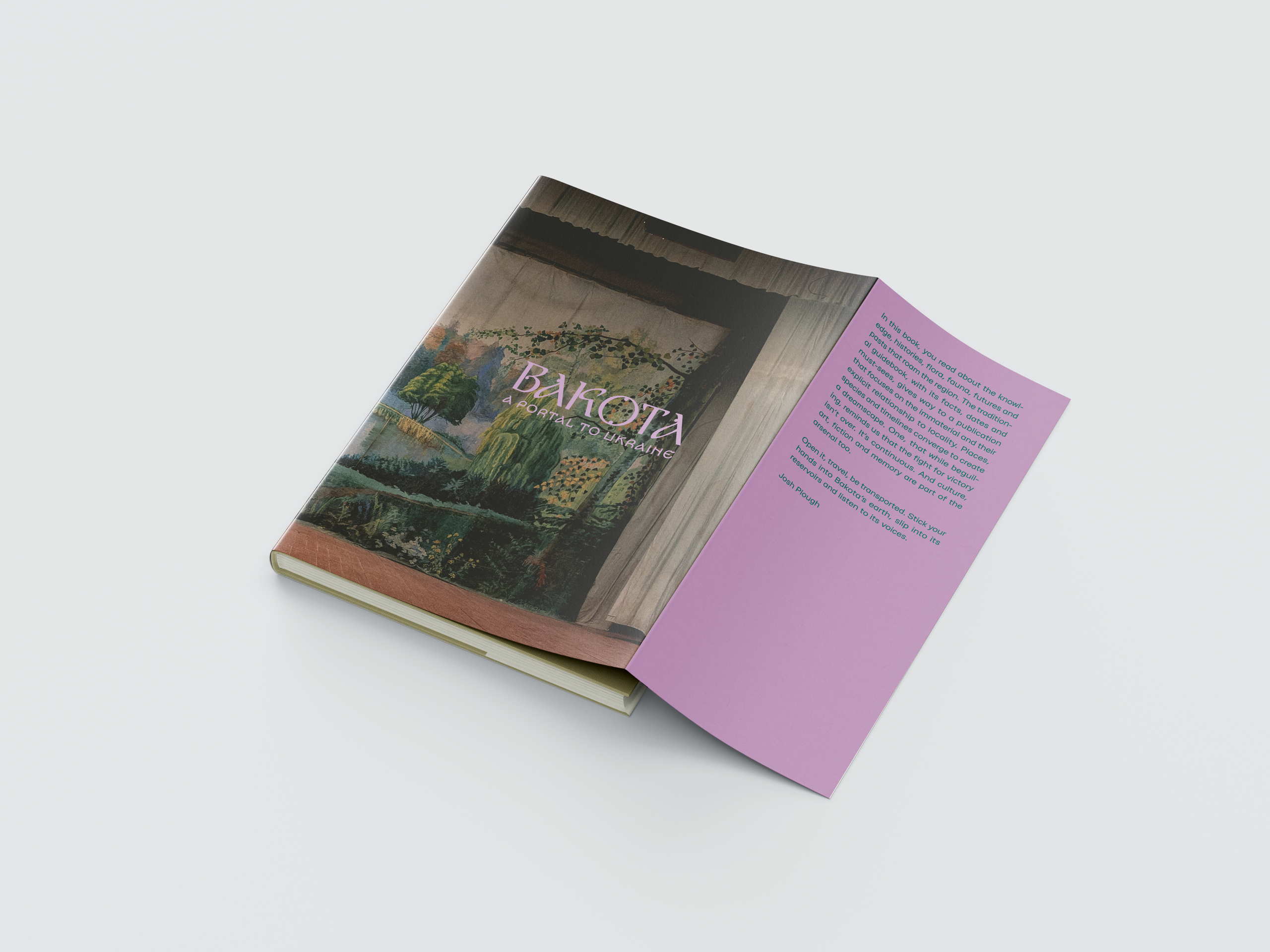
The two artists took part, together with four other artists and writers, in the residency hosted in September 2025 at the Bakota Hub, the cultural centre run by the Ukrainian organisation Territory NGO. Those encounters gave rise to the six itineraries of Bakota: A Portal to Ukraine. Sineglossa, the centre for cultural research and production that also publishes Mangrovia, conceived and coordinated the project and oversaw its artistic direction. Territory NGO managed the residency and community engagement, while the Polish foundation Fundacja Ziemniaki i handled the editorial project and publication. The guide was produced as part of A Discovery Guide for Recovery, co-funded by the European Union’s Creative Europe programme.
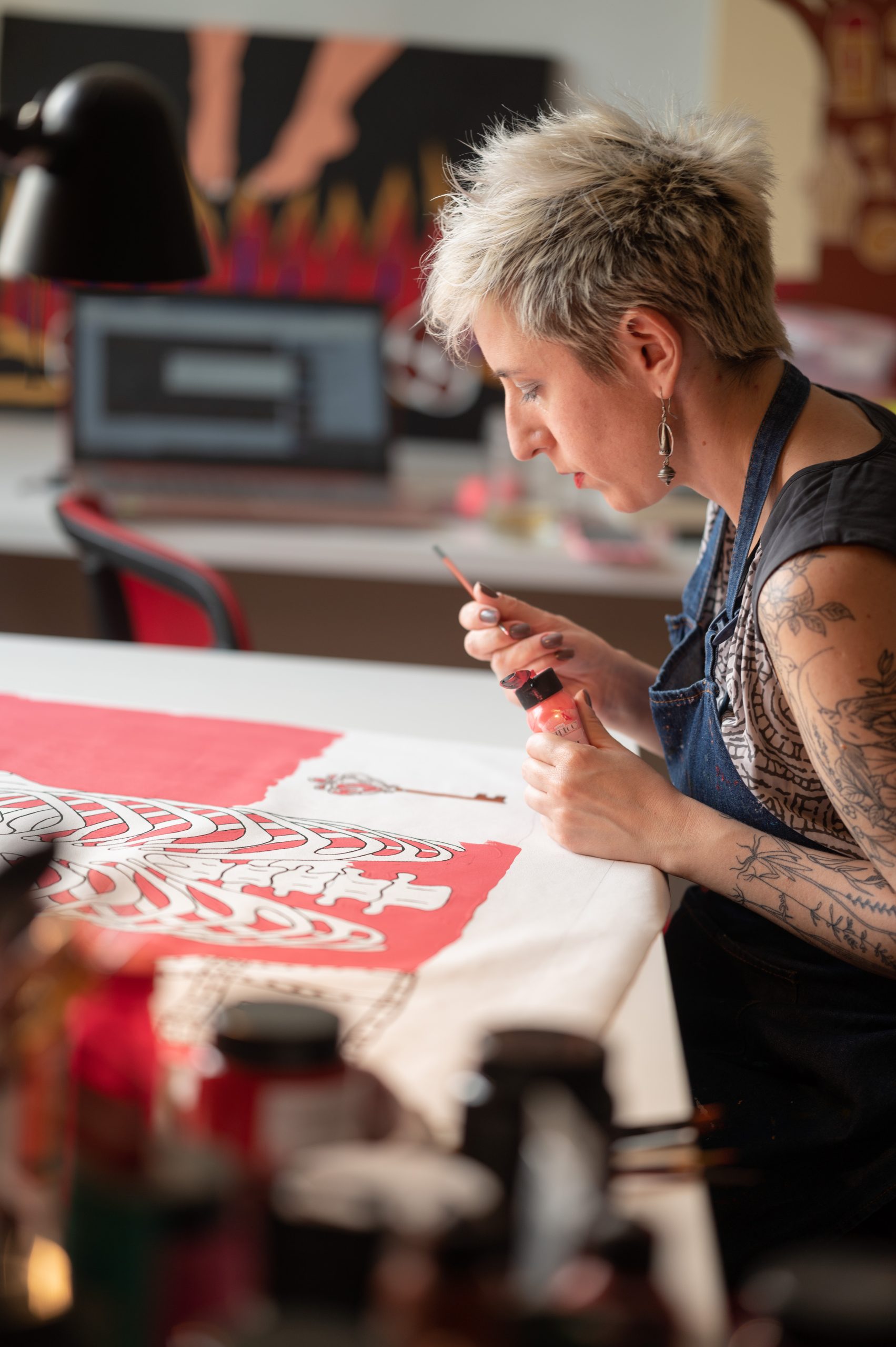
Olena Kayinska
Olena Kayinska is an artist who lives and works in Lviv, Ukraine. Her research belongs to the genre of intellectual primitivism, interwoven with philosophical and psychological narratives. She began her artistic career in 2012. At the heart of her work is an interest in what remains hidden: the sensitive, vulnerable self, rooted in childhood, which takes refuge in the subconscious as a means of survival. Kayinska has taken part in over 100 exhibitions, contemporary art festivals and residencies, and has presented 19 solo projects. She has also curated group exhibitions, artist residencies and relocation programmes supporting artists at risk. Her paintings are held in museums and private collections in Europe, the United States, Turkey and the United Arab Emirates.
Scopri di piùVisita il suo sito
Candles in the wind
In Bakota, in the villages that grew up on the shores of the artificial lake, such as Horaivka, Stara Ushytsia and Kolodiivka, people say the land has a special energy, and there have always been people who practice magic. Olena discovered this as a tourist, before returning for the residency at the Bakota Hub in 2025. “For local people, Bakota is a place of power,” she says. “Practitioners of ancient Ukrainian magic live there, and New Age esotericists arrive, buy houses and organise retreats.” When she asked directly, however, “Is there a witch in your village?”, the answer was always the same: “No, it’s a sin, we go to church.” The turning point came with the community meetings.
The encounter between artists and local residents is the foundation of the Nonturismo method, developed by Sineglossa to build shared narratives of places, and brought outside Italy for the first time with this guide.
“I went to the meetings with residents organised by Territory NGO just for the company, to spend time together,” Olena explains. “I talked about myself, about my life, about how much I loved Bakota and how much I enjoyed being with them.” Only later did she mention why she was looking for healers: for years she had been suffering from insomnia.
With the healers, I set aside the role of journalist, researcher or artist. I introduced myself simply as a person with a problem.
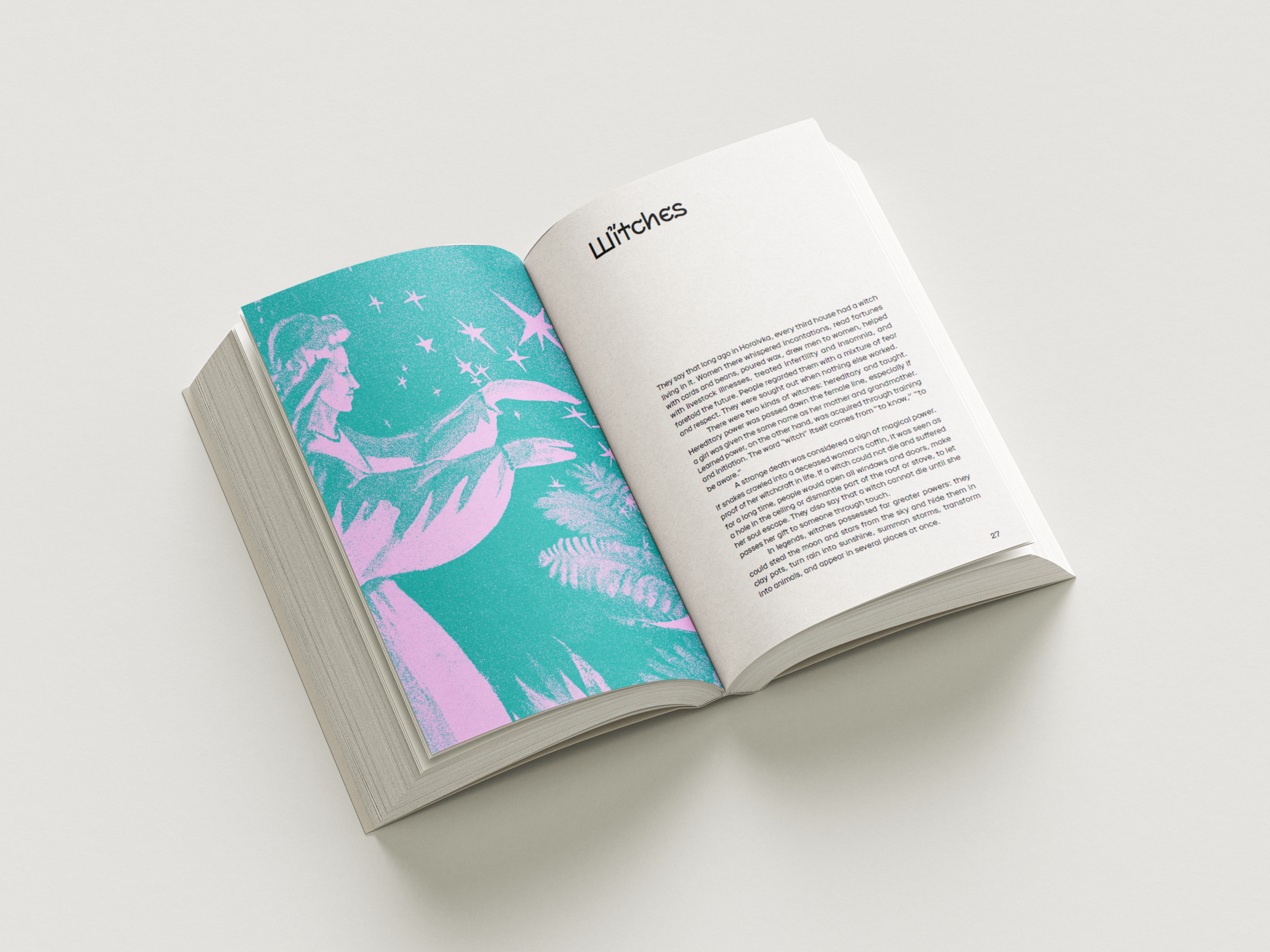
And then someone pointed her to a house, a woman, a road. From there, doors began to open. They told her about the man who spoke with snakes, and about the witch who could not die: she lay in agony for three days, until someone cut a hole in the roof with an axe, like a portal to let her soul out. As she walked through the villages, people would stop her and invite her in: “I have another story for you,” “I have another person you should meet.” Some of them still call her today.
Among the doors that opened was Margarita’s. In her house, Olena found a table covered with an oilcloth, icons, an old stove and two cats. The woman asked her to switch off her phone and not to take photographs, then listened to her story: a difficult period that began in 2019, her grandmother’s illness, a relationship that ended, the sleep that never came back, and the war adding to that exhaustion. Those who ask Margarita for help must draw water from a well in the middle of the night, without being seen and without looking back on the way home. They must sleep with that water beside their pillow and bring it to her in the morning, so that the healer can pour melted beeswax into it while reciting an incantation. As Olena writes in the chapter A Silent Path to Weightless Sleep:
I was waiting for Margarita to examine everything, to show me my fear, to name it and make it visible. As if, once the fear had a shape, it could be taken and carried awa
Like a rite of passage that allows “a traumatic event, which continues to live in someone’s mind” to come to an end “through a shared, repeatable sequence of gestures. As if to say: the witch has done her part, I have done mine. It is over, and I am not looking back.” In the villages along the Dnister, where there are no clinics or psychologists, these figures in fact play a very specific social role and, as Olena explains, “they have to be very wise and know how to give advice, because people come to them with all kinds of problems.”
We recommend reading

For Olena, documenting all this also meant confronting a transmission at risk of being broken. Almost all the healers she met are between eighty and ninety years old; their rituals are passed down by memory, and none of them knows whom to entrust their knowledge to. Their children and grandchildren have moved to the cities, and often laugh at magic. “In the past we had a witch in every third house,” she was told. “Today maybe just one old person per village.” That is why documenting these practices matters, so that “future generations know something about our roots, our culture, our heritage as Ukrainians.” In the guide, these stories take the form of three first-person tales, permeated by the sensations of the rituals and the dreams she had in Bakota. “Maybe Carlos Castaneda, whom I read a lot when I was young, has something to do with it too,” the artist observes. The texts are accompanied by eighteen paintings, selected from over sixty ideas, in which the encounters are reworked through archetypal symbols so as not to reveal the people she met. “Their private lives must be protected,” Olena concludes, and their voices carried “like a candle in the wind,” sheltered just enough to reach someone else.
Until we learn to see them
Camille came to Bakota by a different road. An interdisciplinary artist based in Nantes, she has long worked on the material memory of territories marked by extraction, displacement and conflict. For her, the residency was a chance to get closer to the everyday life of a country at war and to what remains outside media representation. “I wanted to go to Ukraine to understand the context, everything that television and newspapers don’t show,” she explains. “For me, the work always begins with meeting people, with understanding how they live and what they are going through.” She was guided by the desire to understand which resources can be recognised in one’s own environment when access to medicine becomes difficult. “In countries at war, where I often work, getting medicines is quite complicated,” she says. “And yet sometimes we are surrounded by an entire pharmacy, in our own gardens, but we don’t know which plant to use, or why.” In the Bakota countryside she found an unexpected layering of knowledge: in Soviet times the region was a major centre for growing flowers and medicinal plants, and some of those crops have survived to this day. Residents know the cultivated herbs, buy them and use them in everyday life. The wild species, on the other hand, nobody gathers, since there is no need to. Like Olena, Camille tried to unsettle the hierarchy of care we are used to: for two weeks she gathered plants along the roadside, rubbed them between her fingers, smelled them and learned to recognise them. Her days in Bakota flowed slowly, in an almost suspended time that left her room to observe what she calls “small life”: that of insects, flowers, hens and even stones.
“For me it was a form of meditation,” she says. “An almost unconscious return to the bond with the environment from which human beings have never truly separated, even when they stopped noticing it.”
The result was a two-way exchange: from the residents, Camille learned the uses of the cultivated herbs; to them, she gave back what she knows about the wild ones. The wild species growing in Bakota are, after all, the same ones found elsewhere, silent companions across much of the northern hemisphere.
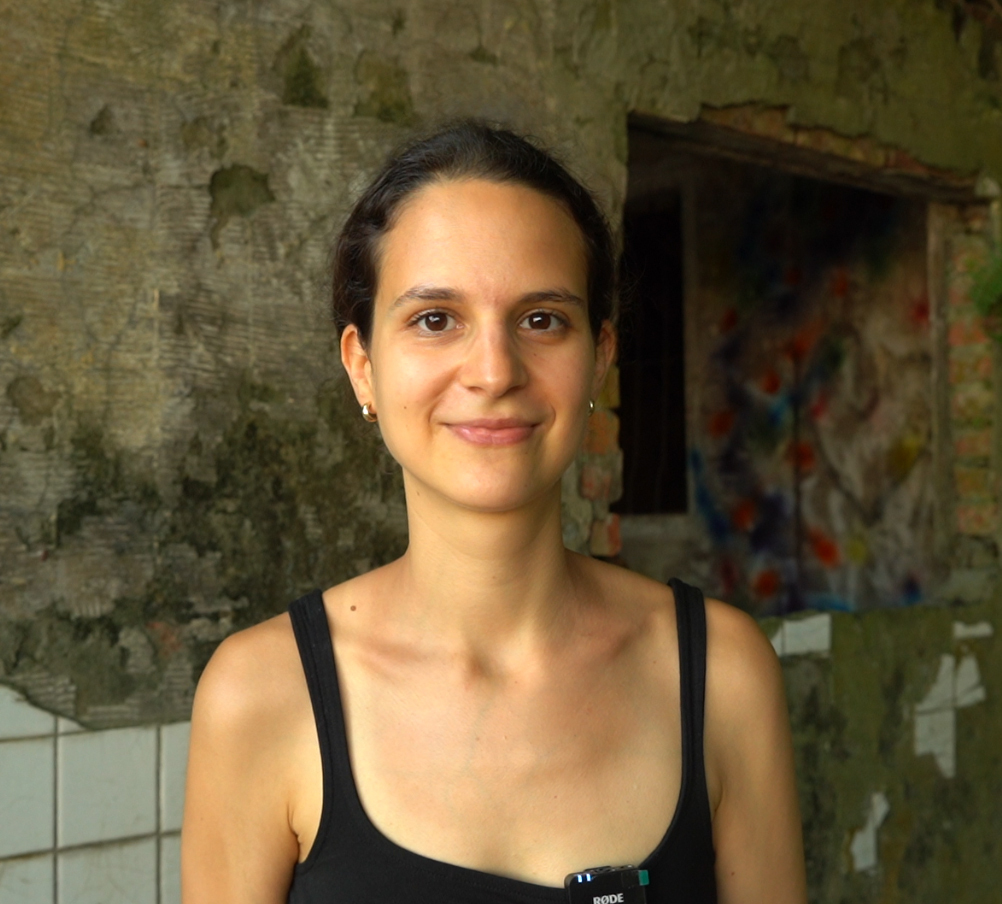
Camille Bleu-Valentin
Camille Bleu-Valentin is a French interdisciplinary artist who lives and works in Nantes. Her practice spans sculpture, installation, performance, printmaking, ceramics, sound and biomaterials. Her work explores colonial histories, the memory of matter and the geopolitics of conflict, investigating how extraction, uprooting and resistance become inscribed in matter and territory. She holds a DNSEP (Diplôme National Supérieur d’Expression Plastique) from the École Supérieure des Beaux-Arts de Nantes and has exhibited internationally, including in Chini Ya Ardhi (Goma, 2025), EXTRA-HERE (Bamako, 2023), Between Two Unparallel Lines (Taipei, 2022) and Polynésiaphonia at The Engine Room (Wellington, 2026). She is the founder of VISA (Valorisation des Solidarités Internationales Artistiques), an association dedicated to promoting cross-border artistic exchange in conflict-affected territories and in places with limited access to resources and opportunities.
Camouflage, the first of Camille’s two works in the guide, presents this mapping: four wild plants common across much of Europe (red clover, plantain, Centaurea nigra and yarrow) are plotted on a map, and then everything else is erased. “If you keep only them, you can see that plants can draw a city too,” she says. “They grow in the gaps left free by asphalt and concrete and give back, in negative, the traces of human habitation. In fact, these species thrive there precisely because someone covered the soil with concrete, and in that transformed environment they found their place. Noticing this, though, requires shifting your gaze.” Just like Olena, who wanted to “open the curtain a little” and spark in readers the curiosity to find out whether there is something more beyond what we see every day. Overlaid, the four distributions also form a camouflage pattern, similar to the one seen everywhere in Ukraine on men’s jackets. “It was my way of telling what I was living through, following nature instead of human beings.”
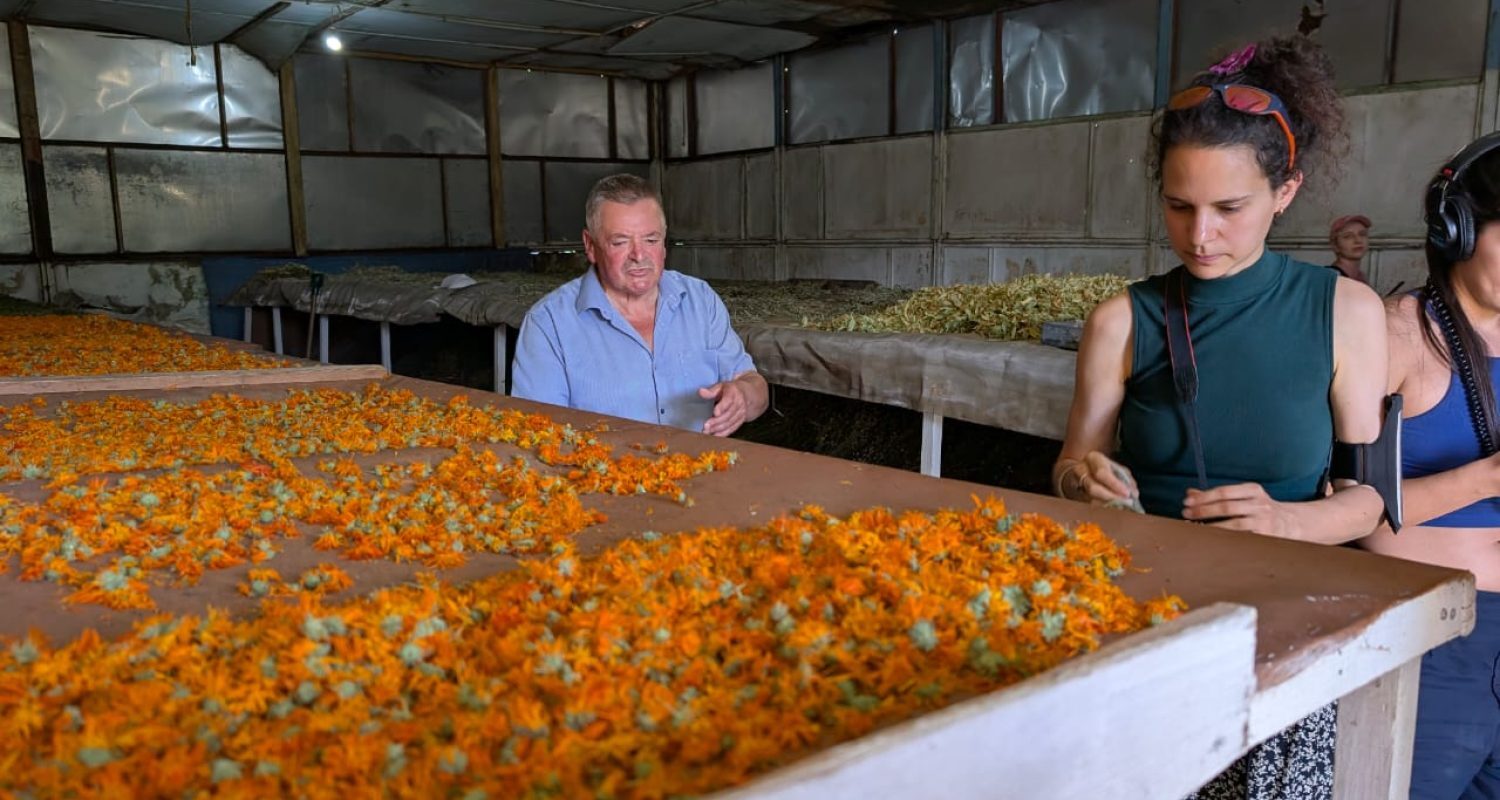
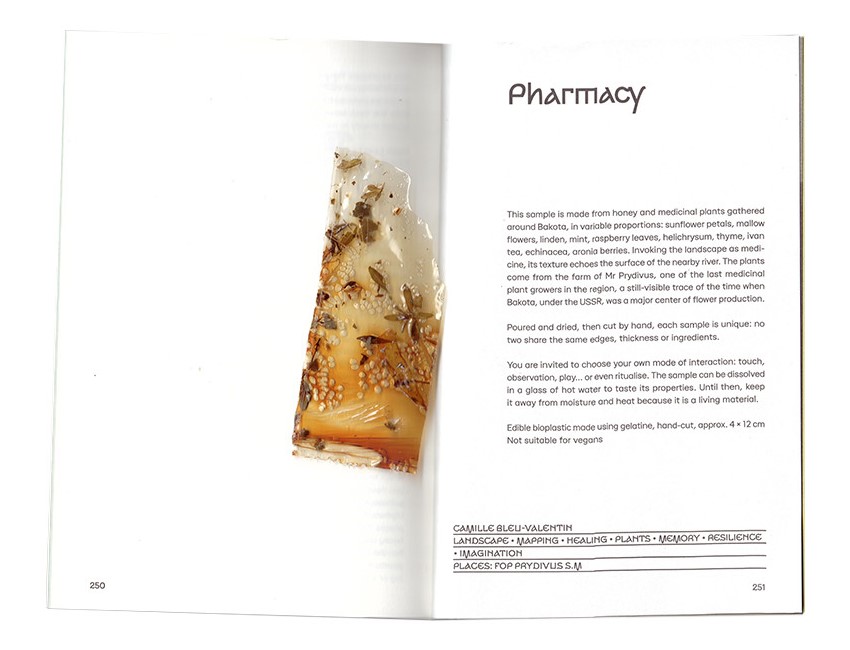
In Camille’s account, this knowledge rooted in the land is therefore less about the effectiveness of remedies and more about relationship and contact. “First of all between people, so as not to be alone. Then with plants, and finally with the land, which also means with our territory, our history, our identity. Returning to something you can touch, feel, see, to the sun on your skin, is essential.” It is no coincidence that the second work Camille brings to the guide, Pharmacy, turns honey and herbs gathered around Bakota, in ever-changing proportions (sunflower petals, mallow flowers, linden, mint, raspberry leaves, everlasting, thyme, fireweed, echinacea and aronia berries), into an edible bioplastic to be looked at, touched or dissolved in a glass of hot water.
“The material is the story,” Camille explains. “And drinking it is like incorporating the history of the territory.”
A situated knowledge, bound to the relationships that run through it, and fragile for precisely that reason. Camille tries to take care of it by asking readers to perform a gesture in turn, and so to step into a tradition rather than simply read about it.
In the villages around Bakota, care travels along different roads. “And this, I think, is where the poetry lies,” says Camille. “It’s always good to know there is another solution, because if for some reason one road stops working, that’s fine: we have others.”
Bakota: A Portal to Ukraine brings together six artistic itineraries, available in an English or a Ukrainian edition. The book is accompanied by Silence Behind the Frontlines, a podcast by Beatrice Petrella with sound production by Jonathan Zenti, recorded during the residency.
To request a copy, find out more about the guide on Sineglossa’s website.
If you work in a bookshop, festival, library or cultural space and would like to host a presentation, write to Sineglossa: info@sineglossa.it.


